
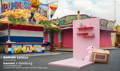
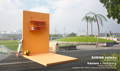
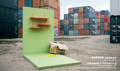
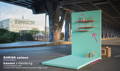
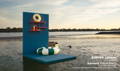
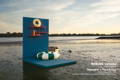
Pioneers and innovators of geometric, self-generating and light structures such as Frei Otto and Buckminster Fuller were the inspiration for this graduation project at the Berlin University of the Arts by Joscha Brose. So too the Green Void by avant-garde architects LAVA, Gaetano Pesce’s ‘Up’ series for B&B Italia and the inflatable street sculptures of Joshua Allen Harris.
Brose’s intention for his long-labelled project: “Making Furniture With a Textile Mould” was to develop an innovative industrial furniture manufacturing process that uses the material efficiency and potential of high tech textiles as well as the cutting edge procedures of the textile industry.
In a digital-analogue process, Brose has created a textile form that can be produced cheaply since 95% of the work is done by a high-frequency robot welder and there are no costly injection mould forms involved. The textile form, or skin, gains its shape and structure by being inflated from within and filled with a structural material – in this case polyurethane foam.
Thus it is the pattern of the outer shell that gives these objects their form and the upholstery becomes a tool in the production process.
The form of Brose’s textile furniture objects fits the physical nature of the process and reflects the extraordinarily efficient geometric structures of Radiolaria grid shells. The endoskeletons of these single-celled Pacific plankton protozoans are formed by the fusion of tiny bubbles.
Thus the grid shell structures of the Textile Moulded Chairs are scaled up reflections of the composition of the foam filling. In addition the six-sided polyhedron structure is also optimised to be compatible with the production technique. The resulting organic form is both a response to modern biomorphic architecture and serves as a ‘living’ accent in contrasting geometric living spaces built in materials such as steel, concrete and glass.